
The screen flickers, the status bar turns a discouraging shade of red, and there it is: a notification that your Vietnam evisa rejected request is final. The frustration isn’t just about the lost fee; it is the absolute silence from the authorities. You are left staring at a digital void, wondering if a typo, a bad scan, or something deeper caused the denial. The Vietnamese Immigration Department rarely provides specific feedback, leaving applicants to play a guessing game with their travel plans. If you find yourself in this position, the first step is to stop hitting refresh and start looking at the technical nuances that usually trigger a decline.
Decoding the silent triggers behind a rejected application
Most rejections are not political or exclusionary; they are mechanical. The system is designed to flag discrepancies that suggest a lack of attention to detail, which immigration officers interpret as a potential security risk. The most common culprit is the passport biographical page scan. If your crop is slightly off, cutting into the Machine Readable Zone (MRZ)—the two lines of text at the bottom—the automated system may automatically ping your profile as invalid. Similarly, any mismatch between the name entered into the online form and the name printed on the MRZ, even a missed middle name or an incorrectly spaced suffix, will trigger a block. The Vietnamese immigration officials are sticklers for data integrity; if your digital entry does not mirror the physical document with surgical precision, it will not pass.
Beyond the technical scan, your occupation can inadvertently complicate the approval process. Listing a generic title like “journalist,” “blogger,” or “photographer” can sometimes trigger a manual review that the standard 3-day turnaround simply cannot accommodate. While these are legitimate professions, they are scrutinized under different lenses in certain jurisdictions. If your background check triggers a manual audit, the system often defaults to a generic rejection rather than asking for clarification, simply to clear the queue. Before you attempt to reapply, ensure that your occupation is listed in the most neutral terms possible. If you were planning on taking a motorbike trip across the Hai Van pass by motorbike, your visa application should reflect that you are a tourist, not a professional documenting the journey, to avoid unnecessary administrative scrutiny.
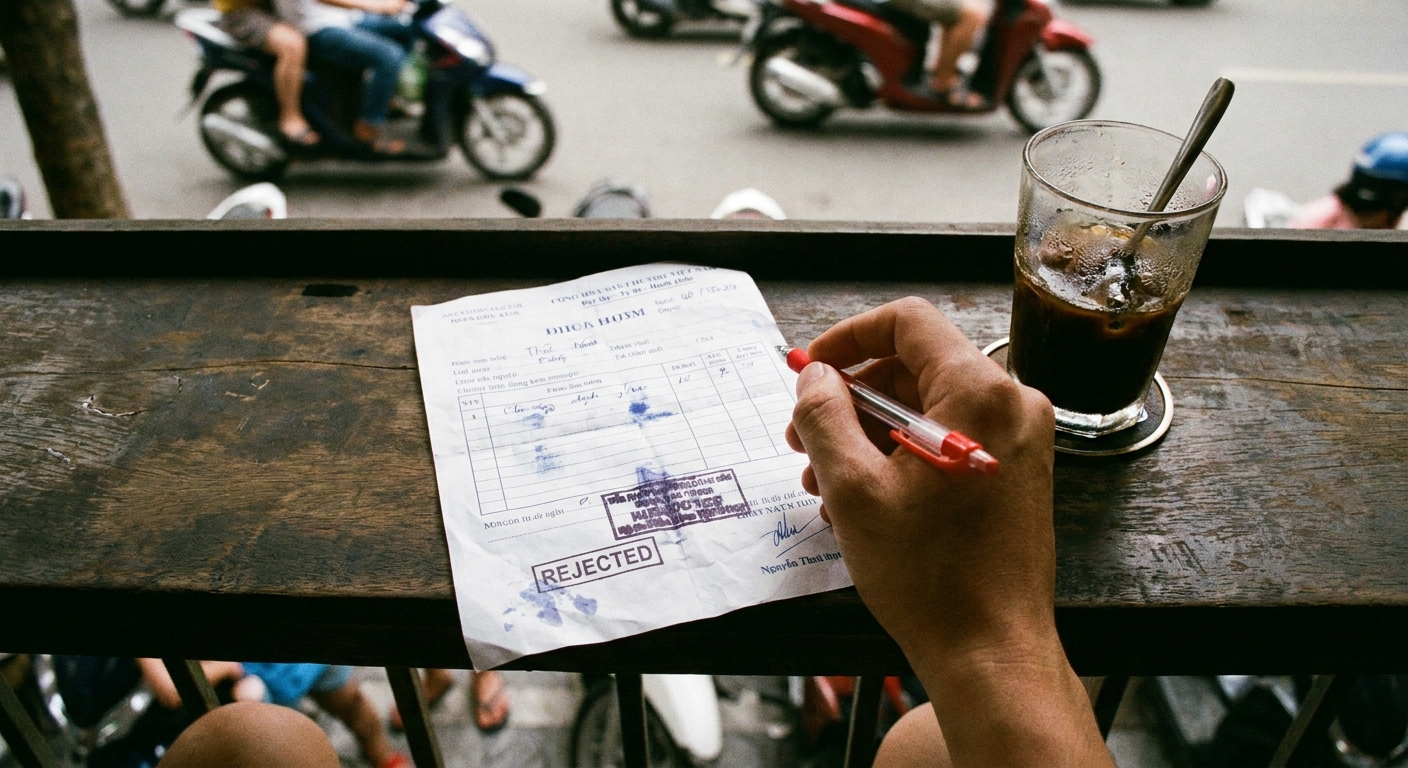
There are also the “ghost” reasons that live in the database. If you have previously overstayed a visa in Vietnam, even by a single day, or if you had an outstanding fine that was never formally resolved, the system will instantly flag your passport number. In these cases, no amount of perfectly cropped photos or corrected names will fix the outcome. If you suspect your history is the issue, it is better to consult with an embassy or a professional service rather than reapplying through the public portal, as multiple failed attempts can create a “black mark” effect that makes it even harder to gain entry in the future.
When you prepare to submit a new application, consider these primary areas for adjustment:

- Double-check that your passport photo is recent, with a plain white background, and shows your entire face without obstruction.
- Ensure your name fields strictly follow the order and spelling found in the bottom two lines of your passport’s data page.
- Review your entry and exit dates to ensure they fall strictly within the valid range of the visa type you selected.
- Verify that the passport scan is high-resolution, glare-free, and captures all four corners of the document.
If you find that the portal is technically broken rather than just rejecting you, it is vital to know when the Vietnam immigration portal won’t let you check your status, as this can distinguish between a system glitch and an actual denial. Rushing into a second application without identifying which of these factors triggered the first Vietnam visa rejection reasons is a recipe for a second consecutive decline. Once you have corrected the data, wait at least 48 hours to allow the system to clear your previous “pending” or “rejected” status from your immediate queue. This buffer period is essential because reapplying while a previous record is still being reconciled by the server often leads to an automated “duplicate” error, which is just as difficult to resolve as the original decline.
Patience is your greatest asset here. If your trip is imminent, do not attempt to force another evisa through the same system if you have already been rejected twice; you are likely hitting a hard block that requires human intervention at an embassy. A clear, honest re-application—stripped of any discrepancies and presented as a standard, compliant request—is usually the most successful path forward. The objective is to make your application so boring, so standard, and so mathematically correct that the system has absolutely no reason to flag it for a second look.